

The Smart Way to Pack Jewellery for a Trip (Without a jewellery Case)
You're packing the night before a trip. Clothes are folded, toiletries are zipped into a pouch, and then you get to the jewellery. A couple of necklaces go into a side pocket. Earrings get dropped into a small bag with a ring or two. A bracelet gets wrapped around your wrist "so it doesn't get lost" and ends up jangling against your suitcase handle instead.
Two days later, at your destination, you open that pouch and find a single tangled knot of metal. One earring is missing its back. A necklace chain has looped itself around a bracelet clasp so tightly that you need a pin and ten quiet minutes to work it loose. Something that should have taken thirty seconds to put on now takes twenty minutes to untangle.
This is one of the most common small frustrations of travel, and it has very little to do with owning "the right" jewellery box. A dedicated jewellery case can certainly help, it's built with separated compartments, padded linings, and hooks designed for exactly this problem. But it isn't the only solution, and for a lot of travellers, it isn't even a necessary one. Most of what causes jewellery to tangle, scratch, or go missing during travel comes down to a handful of avoidable habits: pieces touching each other with no separation, chains left open and loose, and small items with no fixed "home" inside a bag.
The good news is that several ordinary household items, a drinking straw, a button, a soft cloth, a small zip-lock bag, can do a surprisingly good job of solving these problems when used correctly. You don't need to buy anything new. You need a slightly better system.
This guide walks through why jewellery actually gets damaged or tangled while travelling, which household items work well as stand-ins for a jewellery case, and how to pack specific types of jewellery, from hoop and stud earrings to layered necklaces, bracelets, stackable rings, anklets, and a mangalsutra, so they arrive exactly as they left. It also covers material-specific care for gold plated, silver plated, and demi-fine pieces, how to decide what to bring on a short trip versus a longer vacation, whether jewellery belongs in carry-on or checked luggage, how to build a minimal travel jewellery kit, and what to do if something does get tangled or damaged mid-trip.
None of this requires special equipment. It just requires five extra minutes before you close your suitcase.
The Core Problem (Foundational)
1. Why Does Jewellery Tangle and Get Damaged While Traveling?

Jewellery is built to be worn, not to be tossed into a moving suitcase for six hours. Once it's off your body and inside a bag, it's exposed to a completely different set of stresses than it experiences day to day, and most of the damage that happens during travel can be traced back to a small number of causes.
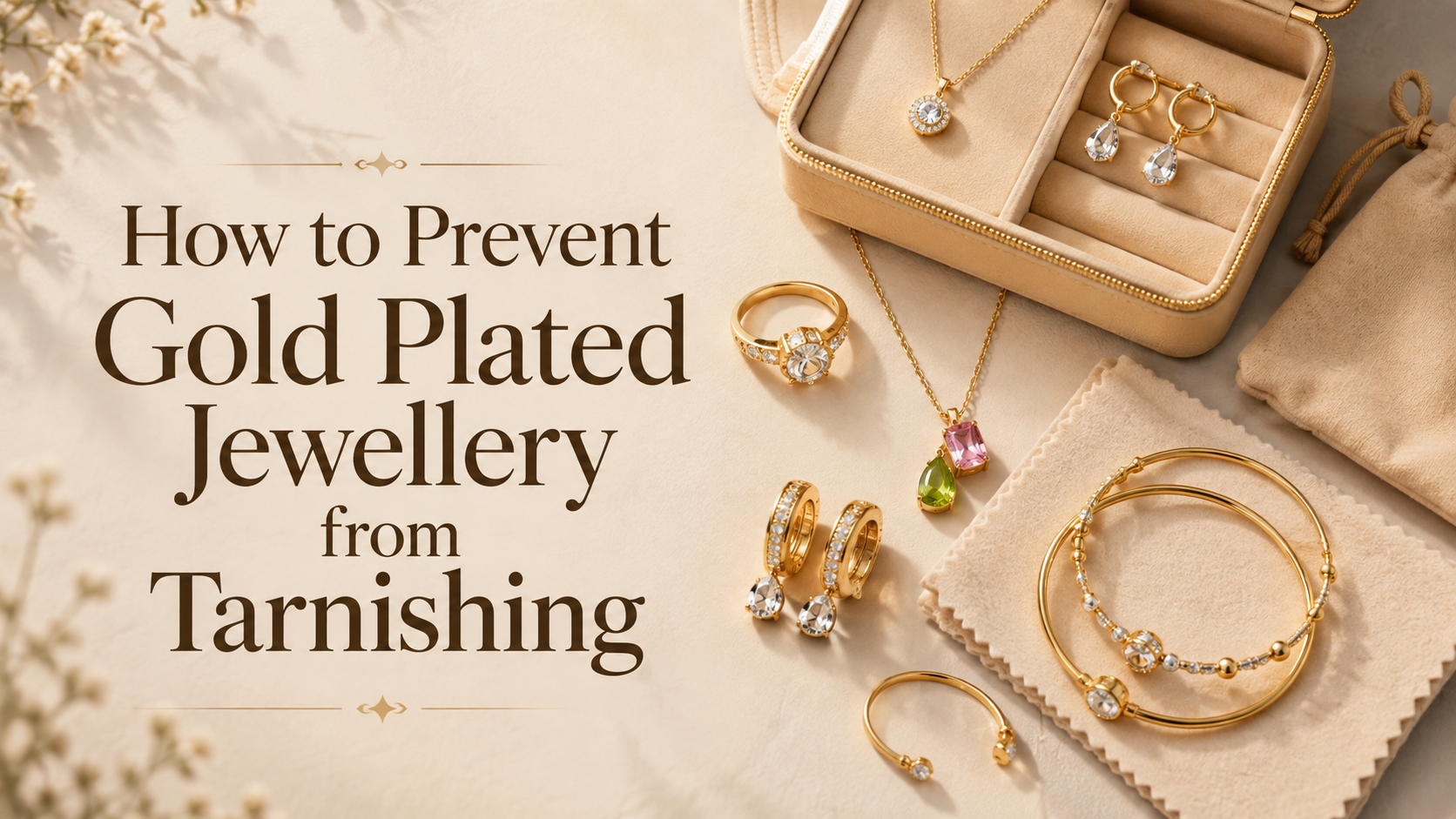
Movement inside luggage.
Every time your bag is lifted, dropped onto a conveyor belt, or shifted around in an overhead bin, everything inside it moves. Loose jewellery items shift against each other repeatedly over the course of a journey, and repeated small movements are what cause chains to twist around one another.
Chains rubbing against one another.
When two or more necklaces are packed together without separation, their links naturally interlace as the bag moves. The finer the chain, the faster this happens.
Clasps catching on other jewellery.
An open clasp is essentially a small hook. Left loose in a bag, it will catch on the nearest chain, earring hoop, or bracelet link it touches.
Earrings separating from their backs.
Earring backs are small, light, and have no fixed attachment to the earring itself once removed. In a bag full of moving items, they're the easiest thing to lose.
Rings getting buried inside clothing or pouches.
Rings have no chain or strap to keep them visible. If they're placed loosely into a pouch or a clothing pocket, they can sink to the bottom or get folded into fabric.
Bracelets becoming tangled.
Chain bracelets behave like miniature necklaces, left loose, they twist around themselves or around anything else nearby.
Anklets getting kinked.
Anklet chains are often finer than necklace chains, which makes them more prone to kinking (small permanent bends) if they're balled up or pulled while tangled.
Pendants getting scratched.
A pendant that swings freely in a bag will repeatedly knock against zippers, buckles, or other jewellery, which is where most surface scratching happens.
Pressure from other luggage.
Jewellery packed near heavy items, shoes, books, toiletry bottles, can get crushed or bent under the weight during transit.
Humidity and moisture.
Bathrooms, humid climates, and even sweat from your own skin can introduce moisture that affects plated and untreated metal surfaces over time.
Sweat, perfume, and cosmetics.
Residue from skin, perfume, sunscreen, and lotion can settle on jewellery surfaces, particularly if pieces are packed while still slightly damp from being worn.
Friction.
Any two jewellery items placed directly against each other, especially metals of different hardness, can create tiny surface scratches through simple contact and movement.
Improper storage and exposure to air.
Jewellery left loose and exposed, rather than wrapped or contained, is more likely to oxidise, tangle, or gather dust.
Temperature changes.
Extreme heat or cold, such as inside a car trunk or an unheated cargo hold, can occasionally affect certain finishes and adhesives, particularly on costume or fashion pieces.
Different types of jewellery are vulnerable to different combinations of these factors, which is why a single packing method rarely works for everything. Here's a quick overview:
|
Jewellery Type |
Common Travel Problem |
Main Protection Needed |
|
Earrings |
Getting lost |
Pairing/secure backing |
|
Necklaces |
Tangling |
Separation |
|
Bracelets |
Scratching/tangling |
Individual wrapping |
|
Rings |
Getting lost/scratched |
Small compartment |
|
Anklets |
Kinking/snags |
Flat storage |
|
Mangalsutra |
Chain/pendant tangling |
Secure separation |
Once you understand which risk applies to which item, packing stops being guesswork and starts being a system, which is really all a jewellery case is trying to give you in the first place.
2. jewellery Case vs DIY Packing Hacks: Do You Really Need One?
A dedicated jewellery case solves the separation problem in one step. It has individual compartments, padded slots, and hooks for necklaces and earrings, so you don't have to think about wrapping or separating anything yourself. For someone who travels frequently with a large or valuable jewellery collection, that convenience is genuinely useful, and it's worth the extra space it takes up in a suitcase.
But a jewellery case isn't automatically the better option for everyone. It's another item to carry, another thing to fit into limited luggage space, and for many travellers, overkill relative to how much jewellery they're actually bringing. If your trip involves five or six pieces rather than an entire collection, a purpose-built case can feel like using a toolbox to carry a single screwdriver.
Here's a more balanced way to compare the two:
|
Factor |
Jewellery Case |
DIY Packing Hacks |
|
Cost |
One-time purchase, added cost |
Free, uses items you already own |
|
Space in luggage |
Takes up a fixed amount of space regardless of how much you pack |
Scales with how much jewellery you're bringing |
|
Convenience |
Very low effort, ready-made compartments |
Slightly more prep time before packing |
|
Flexibility |
Fixed number of slots |
Adaptable to any quantity or combination |
|
Best for |
Frequent travellers, large collections, high-value pieces |
Short trips, minimal jewellery, occasional travel |
Neither option is universally better. A jewellery case tends to make more sense when you're travelling with a wide variety of pieces regularly, or when you want a permanent, reusable system you don't have to rebuild every trip. DIY methods tend to make more sense when you're packing lightly, want to avoid extra luggage bulk, or simply don't want to invest in something you'll use a few times a year.
In practice, the right method usually comes down to a few honest questions:
-
How many pieces are you actually taking?
A handful of items rarely justifies a dedicated case.
-
How valuable are the pieces?
Higher-value jewellery may benefit from the extra structure and padding a case provides.
-
What material are they made of?
Delicate stones or finishes may need more cushioning than a folded pouch offers.
-
How long is the trip?
A weekend trip and a three-week vacation have very different packing needs.
-
Where are you going?
Humid destinations, beach trips, or destinations with less predictable luggage handling may call for more protective packing regardless of method.
-
What do you personally find easiest?
Some people simply prefer having one dedicated pouch they never have to rebuild.
For most short-to-medium trips with a modest jewellery selection, household items, used correctly, do the same job a case does: they separate, cushion, and contain. The next section walks through exactly which ones work best.
3. What Household Items Can You Use Instead of a jewellery Case?
This is the most practical part of the puzzle: what can you actually repurpose from around your home to replace a dedicated jewellery case? The items below are inexpensive, easy to find, and each solve a specific packing problem.
Before using any of them, make sure your jewellery is clean, completely dry, and free of cosmetic residue. Packing a piece while it's damp with sweat, perfume, or lotion traps moisture against the surface, which can affect plating and finishes over the course of a trip.
Drinking straws.
A plastic drinking straw is one of the most effective free tools for packing chain necklaces and bracelets. Threading one end of the chain through the straw before closing the clasp keeps the chain running through a rigid tube instead of lying loose, which limits how much it can twist and knot. Works best for: fine to medium chains. Limitation: not ideal for chunky or heavily embellished chains that won't fit through the straw's opening.
Buttons.
A button with two or four holes makes a simple, functional stud earring holder, push the post through one hole and secure the back on the other side. It also works as a small anchor for stackable rings by threading a chain or string through the button and rings together, though this is best for temporary organisation rather than a full packing solution. Works best for: stud earrings, hoop earrings with posts. Limitation: doesn't cushion against scratches, so pair with a soft pouch or bag.
Small zip-lock bags.
Perhaps the most versatile item on this list. Zip-lock bags keep individual pieces or small groups of pieces sealed away from moisture, dust, and contact with other jewellery. They're especially useful for keeping a matched pair of earrings together, isolating a single necklace, or grouping several rings. Works best for: almost everything, in small quantities. Limitation: doesn't prevent scratching between multiple items in the same bag, so avoid grouping items with different hardness levels in one bag.
Soft cotton cloth or microfiber cloth.
Wrapping an individual piece in a soft cloth before placing it in a pouch or bag adds a cushioning layer that reduces surface contact and friction. This is especially useful for bracelets, pendants, and anything with a delicate finish. Works best for: bracelets, pendants, plated jewellery. Limitation: takes up slightly more space than a flat bag.
Pill organizers.
The small compartments in a weekly pill organiser are ideal for rings, stud earrings, and small stackable pieces. Each compartment keeps items physically separated so they can't scratch each other or get lost together. Works best for: rings, small earrings, tiny charms. Limitation: not suitable for anything with length, like chains.
Contact-lens cases.
Where appropriate, the two small wells in a contact-lens case work well for a single pair of stud earrings or a couple of small rings. Works best for: very small items in pairs. Limitation: limited to one or two items per case.
Small fabric pouches.
A drawstring pouch or a small cosmetic bag gives you a soft, enclosed space for grouping several wrapped pieces together. Works best for: an overall jewellery "kit" that holds several individually wrapped items. Limitation: still needs internal separation to be effective, don't just drop loose jewellery in.
Cardboard.
A small rectangle of cardboard with slits cut into it can hold a necklace in place by threading the clasp and chain through the slits, keeping it flat and immobile rather than free to move and tangle. Works best for: necklaces you want to keep fully flat and untangled. Limitation: takes slightly more prep time to set up.
Tissue paper.
A layer of tissue paper between pieces adds light cushioning, particularly useful when several items are stored together in one compartment or bag. Works best for: light cushioning between multiple small pieces. Limitation: minimal protection against scratching from harder materials.
Small containers or old gift boxes.
Reused small boxes, jewellery gift boxes, mint tins, small containers with lids, provide rigid protection against crushing, which is useful for anything at risk of being squashed under heavier items in a bag. Works best for: pieces that need protection from pressure, like delicate stones or enamel work. Limitation: adds a small amount of bulk and rigidity to your bag.
Coin purses.
A small zippered coin purse functions almost like a miniature jewellery case, with enough room for a few wrapped pieces and a secure closure. Works best for: a compact all-in-one kit for a short trip. Limitation: limited capacity.
Empty compact cases.
An old powder compact or similar flat case, once cleaned out, has a shallow, protected interior that works well for flat items like stud earrings or a couple of rings. Works best for: flat, small items. Limitation: not suitable for anything with volume, like a stack of bangles.
Avoid materials that could react with your jewellery, for instance, avoid direct, prolonged contact with rubber bands (the sulfur in rubber can accelerate tarnishing on silver-plated pieces) and avoid wrapping anything damp or freshly cleaned with chemical solutions. When in doubt, keep it simple: clean, dry, individually wrapped, and separated.
Packing by Product Type
4. How to Pack Hoop and Stud Earrings So They Don't Get Lost in Your Bag
Earrings are small, come in pairs, and have no attachment point once removed, which makes them the single easiest jewellery item to lose while travelling. Whether you're packing hoop stud earrings for a weekend trip or a whole rotation for a longer vacation, the goal is the same: keep pairs together and keep backs secured before anything moves.
Here's a simple, repeatable method:
-
Pair them immediately. As soon as you take a pair off, put them back together, post through the earring back, or hoop closed, before setting them down anywhere.
-
Secure the backs. For stud earrings, push the back on fully rather than leaving it loosely resting on the post. A loose back is the single biggest reason studs get separated in transit.
-
Use a button or small card as an anchor. Push each stud's post through a button hole or a small piece of thick cardboard, then attach the back. This keeps multiple pairs upright and separated instead of rolling loosely together.
-
Protect hoops from being crushed. Hoops, especially thin or lightweight ones, can bend under pressure. Place them in a small rigid container, or slide them onto a straw or rolled cloth so they hold their shape.
-
Keep valuable pairs isolated. If one pair is more valuable than the rest, give it its own small zip-lock bag rather than grouping it with everyday pairs.
-
Create a dedicated earring section. Whether it's one compartment of a pouch or a single small bag, keep all your earrings in one predictable spot so you're not searching your whole kit for a missing back.
This system works whether you're bringing two pairs or eight, the method scales, which is part of why it's a reliable substitute for a dedicated case.
5. How to Pack Layered Necklaces Without Them Tangling Into One Knot

Layered necklaces are, by a wide margin, the jewellery type most likely to end up in a genuine knot by the time you reach your destination. The reason comes down to a few physical factors working together: different chain lengths mean the necklaces sit at different points and move independently; thinner chains have more flexibility and tangle faster than thick ones; and multiple open clasps in the same space act like small hooks looking for something to catch.
The fix isn't complicated, it's separation, done consistently. Here's a five-minute method you can use for any number of necklaces:
-
Clasp each necklace before packing it, even if you're not wearing it. A closed loop is far less likely to catch on something than an open chain.
-
Thread each necklace through a drinking straw, starting from one end near the clasp, leaving the clasp and a small length of chain outside the straw so you can fasten it. This keeps the majority of the chain contained in a rigid tube, which prevents it from looping around other necklaces.
-
Alternatively, use the cardboard method: cut two small slits close together in a flat piece of cardboard, thread the clasp end through one slit and the pendant end through the other, and fasten the clasp on the back of the cardboard. This holds the whole necklace flat and immobile.
-
Wrap each necklace in plastic wrap as a simpler backup method if you don't have a straw or cardboard on hand, loosely wrapping the chain around itself in a flat coil and covering it in a layer of plastic wrap keeps it from unravelling into other pieces.
-
Place each wrapped necklace in its own small zip-lock bag or separated compartment of a pouch, rather than letting multiple wrapped necklaces sit loose together.
-
Layer soft cloth between necklaces if you're storing several in the same section of your bag, adding one more layer of separation and cushioning.
The underlying idea behind all of these methods is the same: reduce how much a chain can move relative to its neighbours. A necklace that's clasped, contained, and separated from other jewellery simply doesn't have the freedom of movement it needs to knot itself, even after hours of luggage handling.
6. How to Pack a Hand Bracelet for Women Without Scratches or Tangles

A hand bracelet for women can mean several different things, a delicate chain bracelet, a solid metal cuff, a set of bangles, or a bracelet with stones or beading, and each type has slightly different packing needs.
Chain bracelets behave like small necklaces. Fasten the clasp before packing, and use the same straw or cardboard method described in Section 5, scaled down for the shorter length. This keeps the fine links from twisting around themselves or catching on nearby jewellery.
Metal bracelets and bangles are more rigid but still prone to surface scratching when they knock against other hard items. Wrap each one individually in a soft cloth before placing it in your bag, and avoid letting multiple metal bangles rest directly against each other, even brief contact during a bumpy flight can leave fine scratch marks.
Delicate bracelets, including anything with fine chains, small charms, or thin settings, benefit from a small zip-lock bag on top of the cloth wrap. The extra layer protects against both moisture and contact with other pieces.
Stone or decorative bracelets need the most cushioning of the group. Stones can chip on contact with harder metal, and prongs or settings can loosen with repeated jostling. Wrap these in cloth or tissue paper and store them in a small rigid container, like an old gift box or compact case, rather than a soft pouch alone.
A few general rules apply across all bracelet types:
-
Always fasten clasps before packing.
-
Never let a metal bracelet sit loose against a stone or enamel piece.
-
Keep bangles in their own section, since their solid shape makes them prone to knocking against and scratching anything softer nearby.
-
Separate bracelets by material where possible — metal with metal, stone with stone — rather than mixing them freely in one pouch.
7. How to Travel with Stackable Rings Without Losing One

A stackable ring is small, light, and has no fixed place inside a bag, which is exactly why it's so easy to lose track of one during a trip. Loosely tossing several rings into the bottom of a pouch might feel convenient, but it's one of the least secure ways to pack them, since they can slide into seams, get folded into fabric, or fall out unnoticed when you open the pouch.
A better approach is to give each ring, or small groups of rings, a fixed spot:
-
Use a pill organiser. Each small compartment holds one or two rings securely, keeps them visibly separated, and prevents them from scratching each other.
-
Thread them onto a button or short length of ribbon. Slipping several stackable rings onto a button loop or a folded ribbon keeps them together as a set rather than loose individual pieces.
-
Wrap them individually in soft cloth if they have delicate stones or detailing, then group the wrapped rings in one small bag.
-
Use individual small zip-lock bags for particularly valuable rings, keeping them separate from the rest.
Because rings are so easy to lose without immediately noticing, it helps to build a simple habit around them: a ring-counting trick. Before you leave your hotel room or pack up at the end of each day, count how many rings you're carrying and check that number against what you started the trip with. This takes seconds and catches a missing ring immediately, while you can still retrace your steps, rather than days later when you're already back home.
8. How to Pack Anklets for Women So the Chains Don't Snag or Kink

Anklets for women often use finer chains than necklaces or bracelets, which makes them more prone to two specific problems: kinking, where the chain develops a small permanent bend from being pulled while tangled, and snagging, where the chain or clasp catches on fabric, especially inside a bag alongside clothing.
To pack anklets safely:
-
Fasten the clasp before packing, exactly as you would with a necklace or bracelet.
-
Store them flat rather than coiled tightly. A loose, flat coil is much less likely to kink than a chain that's been wound tightly or folded on itself.
-
Use a straw for fine chain anklets, threading the chain through before closing the clasp, the same method used for necklaces.
-
Keep pairs together if you're travelling with a matching set, using a small zip-lock bag so they don't separate inside a larger pouch.
-
Wrap heavier anklets in soft cloth. Anklets with beads, charms, or a thicker chain benefit from cushioning, since they're more likely to knock against other items and cause noticeable scratching.
-
Avoid packing anklets directly against clothing seams or zippers, which is where snagging most often happens, keep them inside their own bag or wrap rather than loose in a clothing compartment.
Delicate anklets need gentler handling than heavier ones, so it's worth treating them slightly differently: a fine chain anklet does well with the straw method and a soft pouch, while a heavier, beaded, or charm-style anklet is better suited to individual cloth wrapping and a slightly more rigid container.
9. How to Pack a Mangalsutra Safely While Traveling
A mangalsutra for women typically combines a chain, a pendant, and often black beads, which means it needs a packing approach that protects several different elements at once rather than treating it like a simple chain necklace.
The chain itself is prone to the same tangling issues as any other necklace, so the first step is the same: fasten the clasp before packing, and keep the chain contained rather than loose, using the straw or cardboard method described in Section 5.
Beyond that, a few additional precautions matter specifically for a mangalsutra:
-
Protect the beads. Black beads used in many mangalsutra designs can be delicate and prone to chipping if they knock against harder jewellery or the inside of a bag. Wrap the piece in a soft cloth before placing it in a pouch, rather than letting it sit loose.
-
Keep the pendant from scratching. The pendant is usually the most detailed part of the piece and the most exposed to contact with other items. A small individual pouch or zip-lock bag, on top of the cloth wrap, adds an extra layer of protection.
-
Secure the clasp fully, and check that it's properly closed before placing the piece in your bag — a mangalsutra that comes undone in transit is more likely to tangle with anything else nearby.
-
Keep it separate from heavier jewellery. Pack it away from bangles, cuffs, or anything rigid that could knock against the pendant or beads during transit.
-
Limit exposure to perfume, sweat, water, and cosmetics before packing it. Applying perfume or lotion and then immediately packing the piece while residue is still fresh increases contact with substances that can affect its finish over time.
-
Consider carrying it in your hand luggage rather than checked baggage, particularly given its personal significance and the value many travellers place on it — more on this in Section 14.
There's no single "correct" way a mangalsutra needs to be worn or carried while travelling, that depends entirely on personal and family preference. What matters from a packing standpoint is simply making sure it's transported securely: chain contained, beads and pendant cushioned, and kept away from anything that could scratch or tangle it.
Material-Specific Travel Care
10. How to Travel with Gold Plated Jewellery Without It Fading or Scratching

Gold plated jewellery has a thin layer of gold applied over a base metal, which means the surface is more vulnerable to wear than solid gold. Understanding this helps explain why certain travel habits matter more for plated pieces than for other types of jewellery.
Several everyday factors can contribute to premature wear on plated surfaces:
-
Friction from contact with other jewellery, clothing, or luggage
-
Moisture, including humidity, rain, or damp storage
-
Sweat, which contains oils and salts that can interact with the plating over time
-
Perfume, lotion, sunscreen, and hair products, all of which contain chemicals that can affect a plated finish with repeated contact
-
Water, particularly chlorinated or salt water
-
General chemical exposure, from cleaning products to swimming pools
None of these factors will instantly damage a piece, but repeated or prolonged exposure can gradually wear down the plating faster than normal use would. A few practical habits can help reduce that wear during travel:
-
Clean the piece gently before packing. A soft, dry cloth wipe removes any surface residue from the day before it gets sealed away in a bag.
-
Make sure it's completely dry. Packing a piece while even slightly damp traps moisture against the surface for the duration of the trip.
-
Wrap each piece individually rather than letting plated jewellery touch other metal directly, using a soft cloth or small pouch.
-
Keep jewellery away from toiletries. Store it in a separate section of your bag from perfume, sunscreen, and skincare products, since leaks or residue can transfer easily in a shared space.
-
Put jewellery on after skincare and perfume have fully dried, rather than immediately after application, to reduce direct chemical contact.
-
Remove plated jewellery before swimming or bathing. Pool and sea water in particular can accelerate wear on plated surfaces.
-
Unpack properly on arrival. Don't leave plated jewellery sitting in a closed, humid suitcase longer than necessary once you've reached your destination — take it out, let it air briefly, and store it somewhere dry.
None of these steps guarantee that plating will never wear down, that would depend on the specific piece, how thick the plating is, and how it's used day to day, but consistently following them can help reduce premature wear compared to packing gold plated jewellery loosely and without any protection.
11. How to Pack Silver Plated Jewellery So It Doesn't Tarnish on the Go

Tarnishing is a natural chemical reaction that happens when silver reacts with sulfur compounds in the air, which causes the surface to darken over time. It's a normal part of owning silver or silver plated jewellery, not necessarily a sign of poor quality, but travel conditions can speed the process up if the jewellery isn't stored carefully.
Several factors commonly contribute to tarnishing, and they're worth understanding before you pack:
-
Air exposure, since the tarnishing reaction depends on contact with air
-
Moisture and humidity, which accelerate the chemical process
-
Sulfur-containing compounds, found in some rubber, certain fabrics, and even some foods and cosmetics
-
Sweat, which contains compounds that can react with silver surfaces
-
Cosmetics, including some lotions and perfumes
-
Improper storage, particularly leaving pieces exposed to open air for extended periods
Because tarnishing is driven largely by air and moisture exposure, the most effective packing habits focus on limiting both:
-
Store silver plated jewellery in an airtight or sealed zip-lock bag where practical, which limits ongoing exposure to air during transit.
-
Make sure pieces are completely dry before sealing them away. Trapping any moisture inside a sealed bag can actually make tarnishing worse rather than better.
-
Use anti-tarnish strips or cloths if you have them. These are inexpensive and widely available, and a small strip placed in the same bag as your jewellery can meaningfully slow the process during a trip.
-
Wrap pieces individually rather than letting several silver plated items touch each other directly.
-
Keep silver plated jewellery away from damp clothing, such as swimwear or gym clothes packed in the same bag.
-
Clean and dry pieces before packing them, removing any surface residue from the day rather than sealing it in.
It's worth being realistic here: no packing method will completely stop tarnishing from ever happening, since it's a natural chemical process. What these steps do is slow it down and reduce the chances of a piece coming back visibly duller than when it left, particularly on a longer trip or in a humid climate.
12. Is Demi-Fine Jewellery Safe to Travel With? What to Know Before You Pack

Demi-fine jewellery generally sits between fashion jewellery and fine jewellery, it typically uses higher-quality materials and finishes than everyday costume pieces, such as gold vermeil, higher-grade plating, sterling silver bases, or genuine (though often smaller or lower-carat) gemstones and pearls. That said, exact construction varies significantly between brands, so what counts as "demi-fine" in one collection may differ meaningfully from another.
Because of that variation, it's worth checking a few specifics about your own pieces before deciding how to pack them:
-
Metal composition — is the base metal sterling silver, brass, or something else, and what is it plated or coated with?
-
Plating thickness and type — thicker, higher-quality plating tends to hold up better to travel wear than a thin flash coating.
-
Gemstones — are they set with prongs, glue, or bezel settings, and how securely?
-
Pearls — pearls are porous and can be affected by moisture, perfume, and chemicals more than most metals.
-
Enamel work — enamel can chip on impact, so it needs more cushioning than plain metal.
-
Delicate settings — intricate or open-work settings are more prone to catching on fabric or other jewellery.
-
Clasps — are they sturdy, or fine and easy to bend?
-
Manufacturer care instructions — many demi-fine brands include specific storage and cleaning guidance worth following, especially for travel.
Given this variation, demi fine jewellery generally benefits from more careful handling than simple fashion pieces, though not every piece needs the same level of caution. As a general approach:
-
Store each piece individually, rather than grouping demi-fine items together loosely, since mixed materials and finishes can scratch each other.
-
Avoid moisture exposure, particularly for pieces with pearls or enamel detailing.
-
Protect stones with cushioned wrapping, using soft cloth or tissue paper before placing them in a pouch or small container.
-
Prevent scratches by keeping demi-fine pieces away from harder, unset metal jewellery, like plain bangles or rings.
-
Consider carrying higher-value demi-fine pieces in carry-on luggage rather than checked baggage, given their relative value compared to simple fashion jewellery.
-
Avoid contact with cosmetics, applying perfume and lotion before putting the piece on, and removing it before reapplying either.
It's not accurate to say all demi-fine jewellery needs identical treatment, a sturdy vermeil hoop earring and a pearl-set pendant have very different vulnerabilities. The safest approach is to look at each piece individually and match your packing method to its specific materials rather than treating "demi-fine" as a single category with one set of rules.
Trip Planning & Practical Tips
13. How to Choose Which Jewellery to Bring for a Short Trip vs a Long Vacation
How much jewellery makes sense to pack depends heavily on how long you'll be away and what you'll actually be doing during the trip.
For a short trip — a weekend away, a quick work trip, a two- or three-day getaway, the goal is usually a small, versatile capsule rather than a full rotation. A reasonable starting point looks like:
-
One everyday pair of earrings, such as simple hoop stud earrings
-
One statement pair for an evening out
-
One versatile necklace that works with multiple outfits
-
One hand bracelet for women that pairs well with both casual and slightly dressed-up looks
-
One or two rings, ideally stackable rings that can be worn together or separately
This keeps your jewellery kit small enough to fit into a single pouch, with minimal risk of tangling simply because there isn't much to tangle in the first place.
For a longer vacation, the calculation changes. You're likely dealing with more outfit variety, a wider range of activities, possibly a formal event or two, and changing weather. It helps to think in terms of rotation rather than a single fixed set:
-
Plan around outfit categories rather than individual outfits, casual daywear, evening wear, one formal option, and swimwear or activewear if relevant.
-
Choose jewellery that can rotate across multiple outfits rather than packing a completely separate set for every single day.
-
Account for your destination and its climate, humid destinations call for more attention to plating and tarnish protection; beach destinations mean jewellery should generally come off before swimming.
-
Factor in security and storage at your destination, hotel safes, for example, may only be available at certain accommodations.
-
Bring a slightly wider variety of anklets for women, layered necklaces, and stackable rings if you expect more outfit changes, but resist the urge to pack your entire collection "just in case."
This is the idea behind jewellery capsule packing, building a small, deliberately chosen set that covers the range of things you'll actually wear, rather than defaulting to "bring everything and sort it out later."
|
Short Trip |
Long Vacation |
|
|
Jewellery volume |
Minimal, one capsule set |
Wider rotation across outfit categories |
|
Planning approach |
Pick versatile, everyday-to-evening pieces |
Plan around outfit categories and events |
|
Packing method |
Single small pouch is usually enough |
May need multiple compartments or bags |
|
Risk factors |
Lower, less jewellery to manage |
Higher, more items and longer exposure to travel conditions |
|
Mangalsutra/valuables |
Carry-on where practical |
Carry-on strongly recommended, plus secure hotel storage |
14. Carry-On vs Checked Luggage: Where Should Your Jewellery Go?
As a general rule, valuable or sentimental jewellery is better kept in carry-on or personal luggage rather than checked baggage, though this should always be weighed against your specific airline's rules, your travel insurance policy, and any destination-specific regulations for high-value items.
There are a few clear reasons this approach is generally recommended:
-
Reduced risk of loss. Checked luggage is handled by more people, moved through more systems, and occasionally delayed, misrouted, or lost entirely. Carry-on luggage stays with you the whole time.
-
Easier access. If you need to check on your jewellery, adjust its packing, or simply put a piece on before landing, carry-on luggage is immediately accessible in a way checked baggage isn't.
-
Better control over handling. You know exactly how your jewellery is being carried and stored throughout the flight, rather than trusting it to the general handling process applied to checked bags.
-
Ability to monitor valuables. Particularly for pieces like a mangalsutra or demi fine jewellery with real sentimental or monetary value, having them within reach reduces the anxiety of not knowing where they are for hours at a time.
What generally shouldn't be casually packed into checked luggage: anything irreplaceable, anything of significant monetary value, and anything you'd have real difficulty replacing if it went missing. Everyday fashion pieces with low replacement value are a lower-stakes decision either way.
That said, policies vary. Some airlines have specific rules about valuables in checked baggage, and some travel insurance policies exclude high-value jewellery from coverage in checked luggage entirely, or require it to be declared separately. It's worth checking your airline's baggage policy and your insurance provider's terms before a trip, particularly if you're travelling internationally or carrying anything of real value, rather than assuming one universal rule applies everywhere.
15. How to Build a Minimal Travel Jewellery Kit That Still Covers Every Outfit

A well-chosen small set of jewellery can cover far more outfit combinations than most people expect, as long as the individual pieces are chosen for versatility rather than novelty. This is the core idea behind a minimal travel jewellery kit — fewer pieces, each one doing more work.
A simple framework to start from is the 5-piece travel jewellery kit:
-
Everyday earrings — a comfortable, low-maintenance pair like simple hoop stud earrings that you can wear for most of the trip without a second thought.
-
Statement earrings — one slightly bolder pair for evenings out or a special occasion.
-
A versatile necklace — ideally one that works with both casual and dressier outfits; if you enjoy layered necklaces, choose two or three that were designed to be worn together, so they double as either a single necklace or a layered look.
-
A bracelet — one hand bracelet for women that's neutral enough to pair with most of your outfits, whether it's a simple chain or a metal cuff.
-
Two versatile rings — ideally a couple of stackable rings that can be worn together for a fuller look or separately for something more understated.
From here, these five categories can flex across almost any occasion:
-
Casual outfits — everyday earrings, one ring, done.
-
Office or travel-day outfits — everyday earrings plus one subtle ring, kept simple and low-maintenance.
-
Dinner or evening plans — swap in statement earrings, add the necklace, wear both rings stacked together.
-
Weddings or events — layer the necklace pieces together, add statement earrings and the bracelet for a fuller look.
-
Traditional outfits — the necklace and bracelet combination generally adapts well here, and if relevant, a mangalsutra can be added to this same kit with its own separated storage, as covered in Section 9.
-
Western outfits — everyday or statement earrings paired with a single ring keeps things simple without overpacking.
A basic packing checklist for this kit:
-
Everyday earrings, backs secured
-
Statement earrings, backs secured, wrapped separately
-
Necklace(s), clasped and packed using the straw or cardboard method
-
Bracelet, wrapped in soft cloth
-
Two rings, stored in a pill organiser or small pouch compartment
-
Anklet, if bringing one, packed flat with the clasp fastened
-
Mangalsutra, if bringing one, wrapped separately and stored in carry-on
-
Any demi fine or gold plated jewellery, individually wrapped and kept away from other pieces
Keeping the kit small isn't just about saving space — it also means less to keep track of, less chance of tangling since there's simply less jewellery in contact with itself, and a much faster job putting everything back together at the end of the trip.
16. What to Do If Your Jewellery Gets Tangled or Damaged Mid-Trip

Even with careful packing, something can occasionally go wrong. Here's how to handle the most common issues without making them worse.
If a necklace gets tangled:
-
Don't pull on it aggressively — this tends to tighten knots rather than loosen them, and can stress or bend the chain's links.
-
Place it flat on a hard surface, like a table or countertop, where you can see the whole knot clearly.
-
Use a fine pin or needle to gently work into the knot, easing links apart one at a time rather than trying to pull the whole thing free at once.
-
Loosen one small section before moving to the next, working from the loosest part of the tangle inward rather than starting at the tightest point.
If an earring is lost:
-
Check likely hiding spots systematically: clothing pockets and seams, the inside lining of your bag, hotel bedding and carpet, and bathroom counters or sink areas.
-
Keep the remaining earring somewhere secure and separate rather than continuing to carry it loose, in case the pair is found later or you need to have a replacement made.
If gold plating gets scratched:
-
Avoid abrasive cleaning or scrubbing, which can wear down the remaining plating around the scratch.
-
Don't try to aggressively polish it back to a shine — this can remove more plating rather than restoring it.
-
Store the piece separately from other jewellery until you're able to have it properly assessed or repaired, since a scratched edge can catch on other items more easily.
If silver-plated jewellery tarnishes:
-
Follow the specific brand's care instructions if you have them, since cleaning methods vary based on the exact plating and base metal used.
-
Use a method appropriate for plated (not solid) silver — a jewellery-specific polishing cloth is generally the safest option while travelling.
-
Avoid harsh chemicals, including household cleaning products, which can strip plating rather than simply removing tarnish.
If a clasp breaks:
-
Store the piece somewhere secure rather than continuing to wear or carry it loosely, since a broken clasp means the item can come apart or get lost entirely.
-
Avoid wearing it again until it's been repaired, particularly for anything with sentimental or monetary value.
A short "Before You Leave the Hotel" checklist is worth running through each time you check out or move on to a new destination:
-
Count your rings against your starting number
-
Confirm both earrings of each pair are together
-
Check that all necklace and bracelet clasps are fastened
-
Make sure nothing is loose in a bag pocket or clothing item you're about to leave behind
-
Confirm valuable pieces, including a mangalsutra if you're carrying one, are in your carry-on or personal bag rather than left in checked luggage or a hotel drawer
Frequently Asked Questions
Can I travel with jewellery without a jewellery case?
Yes. A dedicated case is convenient, but household items like straws, small zip-lock bags, soft cloth, and pill organisers can separate and protect jewellery just as effectively for most trips.
How do I stop necklaces from tangling in my luggage?
Fasten each clasp before packing, keep each necklace separated from the others using a straw, cardboard, or individual bag, and avoid letting multiple chains sit loose together in the same space.
Is it safe to put jewellery in a zip-lock bag?
Generally yes, as long as the jewellery is clean and completely dry before sealing it. Trapping moisture inside a sealed bag can be counterproductive, particularly for silver plated pieces.
Should I keep jewellery in my carry-on?
Valuable or sentimental jewellery is generally safer in carry-on or personal luggage rather than checked baggage, though it's worth checking your airline's and insurer's specific policies.
How do I protect gold plated jewellery while travelling?
Keep it clean, completely dry, and individually wrapped, away from perfume, lotion, and direct water exposure, and put it on only after skincare products have fully dried.
How do I prevent silver plated jewellery from tarnishing?
Store it in a sealed, dry bag, ideally with an anti-tarnish strip, and keep it away from moisture, damp clothing, and prolonged air exposure.
Can I travel with demi fine jewellery?
Yes, but check the specific materials, stones, and care instructions for each piece first, since demi-fine construction varies by brand, and pack more delicate elements like pearls or enamel with extra cushioning.
How should I pack earrings so they don't get lost?
Pair each set immediately after removing it, secure the backs fully, and anchor studs to a button or small card so they stay upright and separated rather than loose.
How much jewellery should I take on vacation?
For a short trip, a small capsule of five or six versatile pieces is usually enough. For a longer vacation, plan around outfit categories rather than packing an item for every single day.
What should I do if my jewellery gets tangled while travelling?
Lay it flat, avoid pulling on the knot, and use a fine pin to gently loosen one section at a time rather than forcing the whole tangle apart at once.
Final Thoughts
You don't necessarily need a dedicated jewellery case to travel with your jewellery safely. What actually protects your pieces has less to do with the container and more to do with a few consistent habits: keeping items separated so they can't tangle or scratch each other, storing everything dry, wrapping delicate pieces individually, and matching your packing method to the specific material you're carrying, whether that's gold plated jewellery, silver plated jewellery, or demi fine pieces with stones or pearls.
A straw, a button, a soft cloth, and a couple of small zip-lock bags can do almost everything a purpose-built case does, at no extra cost and with no extra bulk in your luggage. The method scales with you — a short trip might need nothing more than one small pouch, while a longer vacation might call for a few separated compartments and a bit more planning around outfit rotation.
The real difference between jewellery that arrives tangled and jewellery that arrives exactly as it left usually comes down to five minutes of preparation before you close your bag: clasps fastened, pairs kept together, pieces wrapped individually, and valuables placed somewhere you can keep an eye on them. Building that habit into your packing routine, rather than reaching for everything loosely at the last minute, is what actually keeps jewellery safe on the road — case or no case.